
Bayer's Universal: Simplified Communication
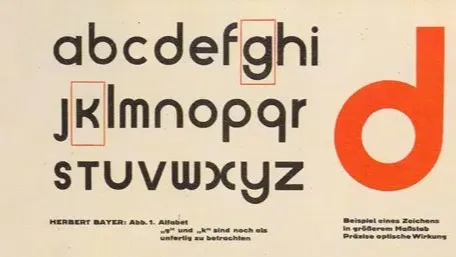
Herbert Bayer's "Universal" typeface aimed to simplify written communication ✍️
Herbert Bayer, a pivotal figure at the Bauhaus, conceptualized typography as a core component of rational communication design. His approach rejected superfluous ornamentation, advocating instead for a functional clarity that aligned with the school's commitment to integrating art, technology, and utility. For Bayer, the written word was not merely content but a visual structure, demanding a streamlined, universal aesthetic for the modern age.
This vision materialized in his "Universal" typeface, developed in 1925. A radical departure from traditional orthography, the Universal typeface was designed as a single-case (lowercase only) sans-serif script. Its geometric construction, based on circles, straight lines, and simple arcs, aimed to eliminate visual redundancy and enhance legibility. Bayer's ambition was to simplify written communication fundamentally, proposing a unified alphabet system that would rationalize reading and writing, thus embodying the Bauhaus ideal of efficiency and clarity.
Base Material
- Droste, Magdalene. *Bauhaus: 1919-1933*. Taschen, 2019.
- Lupton, Ellen. *Thinking with Type: A Critical Guide for Designers, Writers, Editors, & Students*. Princeton Architectural Press, 2010.
- Spencer, Herbert. *Pioneers of Modern Typography*. Lund Humphries, 2004.
- Bayer, Herbert. *Herbert Bayer: Painter, Designer, Architect*. University of Chicago Press, 1984.