
Defining Bauhaus: Form, Hue
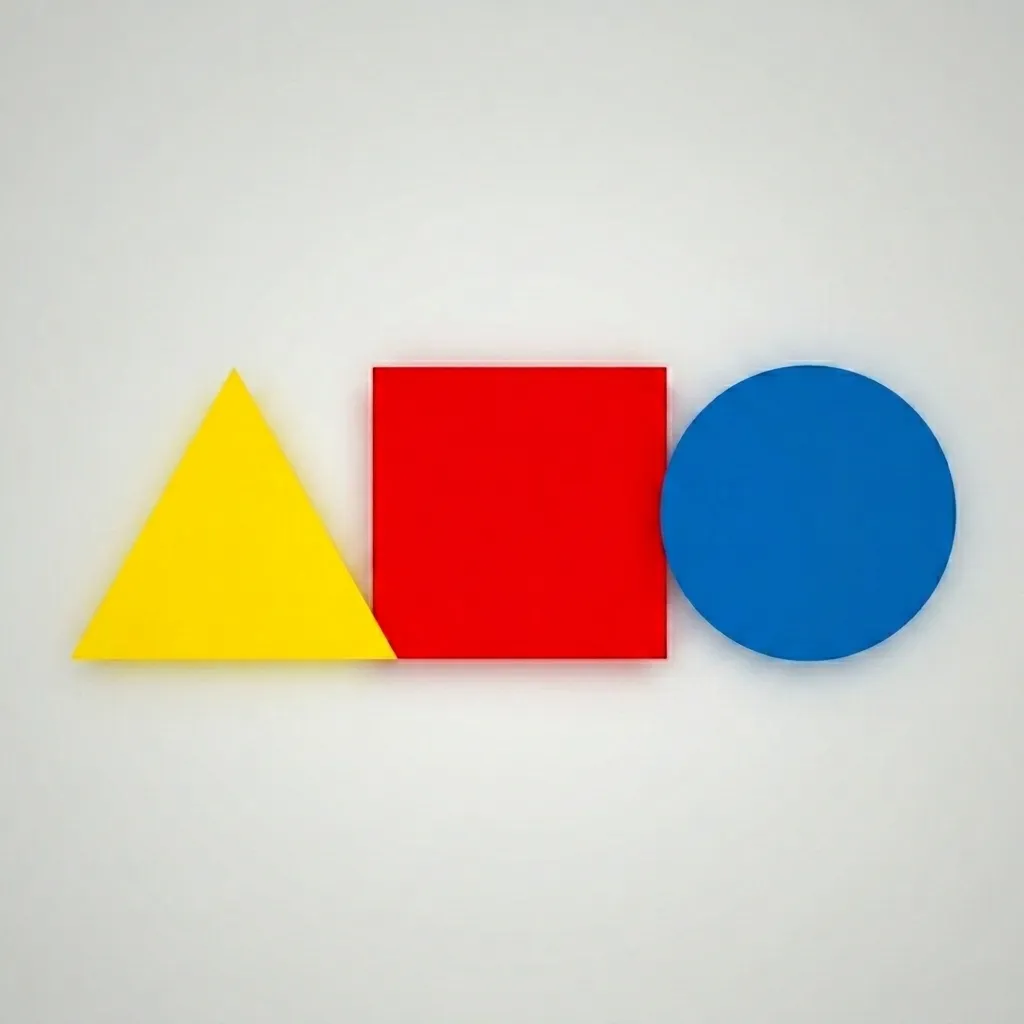
Bauhaus design is characterized by the use of simple geometric shapes and primary colors. 🔴🟡🔵
When the Bauhaus movement set out to reinvent the modern world, they did not just simplify design—they stripped it down to its absolute elemental DNA: basic geometric shapes and primary colours.
To masters like Wassily Kandinsky and Johannes Itten, this was not merely an aesthetic trick; it was a psychological science. They believed that elementary forms possessed inherent spiritual energies that could be unlocked when paired with the right hue.
Kandinsky’s Cosmic Questionnaire
In 1923, Kandinsky distributed a now-famous survey at the Weimar school, asking students and faculty to intuitively fill a triangle, a square, and a circle with red, yellow, and blue. The overwhelming consensus confirmed his theory of a universal visual language:
The Yellow Triangle: Representing sharp, eccentric energy, weight, and spiritual aggression.
The Red Square: Symbolising stability, structural ground, and calm, earthly matter.
The Blue Circle: Evoking deep concentric thought, the spirit, and endless infinity.
The Universal Rule: For the Bauhaus, design was about reducing visual noise. By discarding historical ornament and sticking strictly to the pure synthesis of primary shapes and colours, they created an industrial aesthetic so powerful it still dictates modern minimalism today.
Base Material
- Gropius, Walter. The New Architecture and the Bauhaus. The MIT Press, 1965.
- Droste, Magdalena. Bauhaus: 1919–1933. Taschen, 2006.
- Frampton, Kenneth. Modern Architecture: A Critical History. Thames & Hudson, 2007.
- Siebenbrodt, Michael, and Lutz Schöbe. Bauhaus. Parkstone International, 2017.